Rebuilding a 7,500-product Shopify store without losing rankings
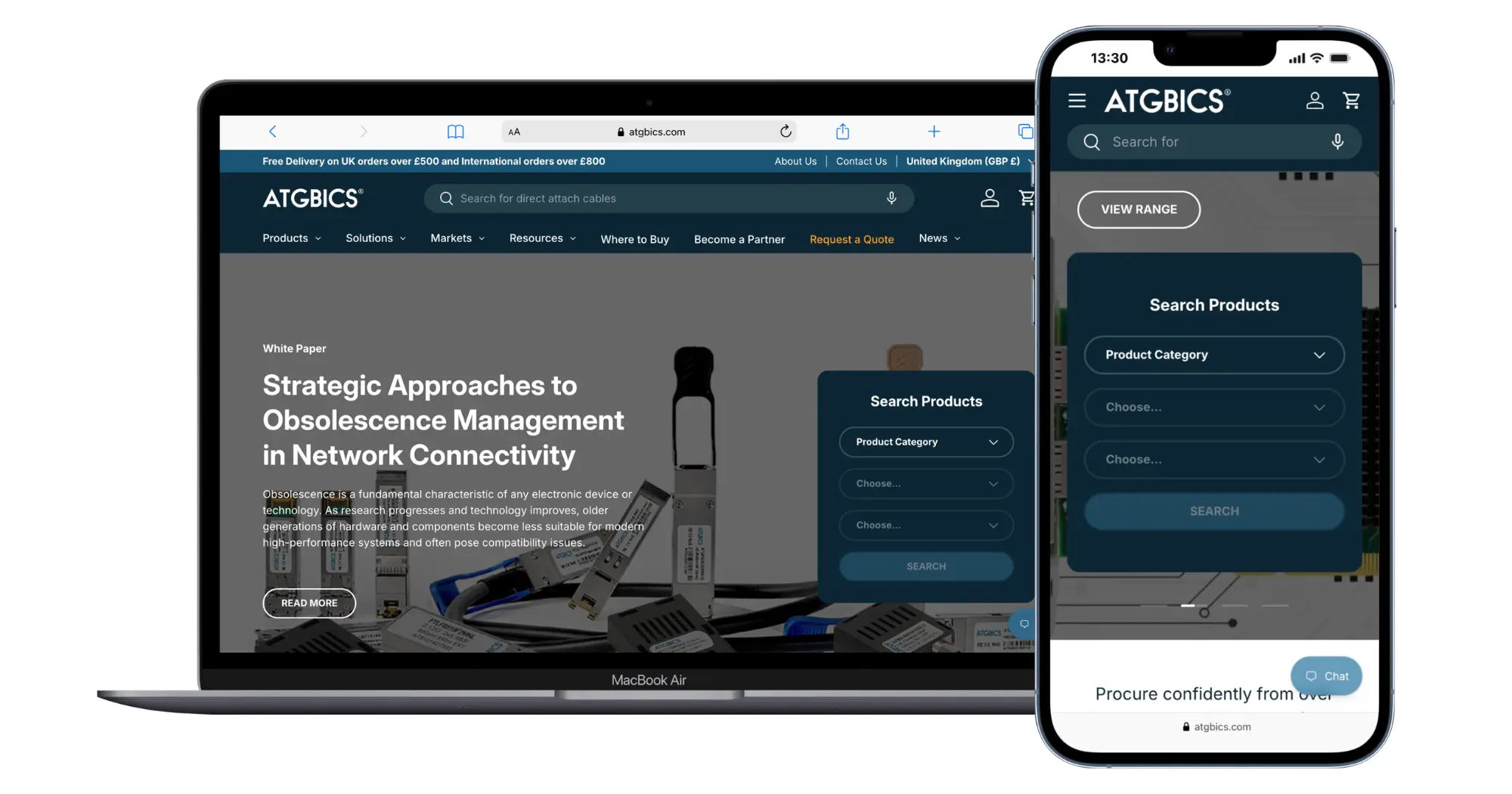
ATGBICS supply compatible network transceivers to industrial and enterprise customers worldwide, shipping from the UK to dozens of countries. Their Shopify store had grown organically over years, with thousands of products, inconsistent data and navigation that made finding the right part harder than it should have been. We rebuilt it on Shopify 2.0.
Strategy and execution
Shopify 2.0 rebuild
We upgraded the theme and built bespoke sections for the product and category templates the range actually needed.
Filtering that works
Metafield-driven filters let customers narrow by vendor, specification and form factor, rather than scrolling through thousands of parts.
URLs left alone
ATGBICS rank in the top three for thousands of part codes, so every existing URL structure was preserved through the move.
The problem
ATGBICS supply compatible network transceivers and connectivity kit to industrial and enterprise customers, shipping from the UK to dozens of countries. It's a business where the customer often knows precisely which part they need, down to the code.
Their Shopify store had grown with the business rather than being designed for it. Thousands of products, data entered inconsistently over several years, specification tables built as hand-written HTML that fell apart on anything smaller than a laptop, and a navigation structure that assumed you already knew what you were looking for.
There was a complication. ATGBICS rank in positions one to three on Google for thousands of specific part codes. That's high-intent search that converts straight to a sale, and all of it sat on URLs we were about to touch.
What we did
We upgraded the theme to Shopify 2.0 and built bespoke sections for the product and category templates.
Product data came next, and it was most of the work. Around 7,500 SKUs went through Matrixify to fix formatting and standardise specifications, which then let us rebuild the spec tables as responsive, metafield-driven grids rather than hand-written HTML.
With clean data behind them, the filters could do something useful. Customers can now narrow by vendor, specification and form factor. We also added a B2B purchasing flow for the resellers and distributors buying in volume.
Every existing URL structure was preserved. Not glamorous work, but it's the difference between a migration and an accident.
Outcome
The new store launched on 20 May 2024, and search performance held through the move, which was the main thing.
Comparing Q1 2026 with the same quarter a year earlier, net sales were up 61 per cent and average order value up 22 per cent. Sessions grew 368 per cent, though I'd be careful attributing all of that to the rebuild. ATGBICS have invested heavily in content and new product categories since launch.
Which is really the point. The platform has scaled with them, from around 7,500 products at launch to more than 20,000 today. They've since achieved ISO 9001:2015 certification and run the site themselves.
The results
Year on year growth, Q1 2026 against Q1 2025.
Net sales, Q1 2026 vs Q1 2025
Growth in sessions
Average order value
Total sales
Webcetera have proven to be one of our most valued service providers. Their commercially aware approach preparing for and delivering the successful redevelopment of our website was very professional. I would have no hesitation in recommending Webcetera for similar projects.
ATGBICS
Fancy something similar?
We work with some good people. If you'd like to be one of them, get in touch.